
Prologue: The Lock is the Key
Ahem.
He wants to tell a story about a journey to waking up, but he cannot remember how it begins. Oh, he can remember enough of what comes after a point, five years old in fact, but it’s the real beginning, the time before that, that hides in a void as dark as a night in the wilderness backcountry so thick with emptiness that even the stars do not shine and when only the odd, invisible sounds of the night make their presence known. But it doesn’t stop there; it is more than that. His is a life lived absent of its own self far beyond the earliest five years. Something happened in that place where his memory doesn’t go that made it impossible for him to be fully present. Hindsight tells us if we are not present with ourselves, then we are also absent from the surrounding life. So the telling of that time, as it looks through his sixty year old eyes, must be as much by his imagination as by facts.
In the absence of tangible recollections, a story like this must therefore rely upon less direct means to fulfill itself. There are patterns exhibited in later years that give clues to the ingredients in the formative soup: the mental void, an inability to identify and communicate feelings and a vocabulary starved for adjectives that could be used to describe them, debilitating self-consciousness, delayed bowel control, ulcer at age 12, a volatile temperament, fear in virtually ever aspect of living that involved other people, and self propelled erotic fantasies.
Of his earliest history, what he does have are less than a handful of stories that have been reported by those most likely to remember, even if their remembering is more about them than him. And imagination. Further down the road, he would realize that he couldn’t trust their memories any more than he trusted them to be honest in their intimacy. This had less to do with the truth, that mutable ambiguousness, and more to do with intimacy, which was not in the mix. As a family they never went there. Honesty might have been easy enough — they really did believe that what they remembered was the way it actually was — but then they were preoccupied by the business of learning how to attend to their own lives and were only supervising his. Deep, revealing, trust-building intimacy, however, had always been missing.
His maternal grandparents, whose more tangible familial presence would recalibrate his life each summer into his mid-teens, preserved and relayed a few more stories from the time before his memory. Each tell of moments when as a toddler he escaped the protective adult restraints. The highway that passed forty feet in front of his grandparents Oregon home was always busy with traffic. Most notably, logging trucks running their routes from forest to the mill in town, fully loaded, and then back empty again, highballed it up and down the two-lane. A panicked search quickly led to the most dangerous possibility up front where Grandpa found him exploring the gravel shoulder on the other side of the fence. “How’d you get outside the fence?” Grandpa asked, and he eagerly showed how he had outsmarted the gate. The second disappearing act did not resolve itself as quickly. Grandpa had made the gate impassable, they thought, although their first search was devoted to exploring the thoroughfare and the ditches on both sides. But no sign. From the kitchen, Grandma eventually noticed something in the pasture with Ol’ Baldy. Grandpa found his little grandson crawling among the legs of the big steer, being licked clean as if Ol’ Baldy was his mother. He remembers asking his grandparents about the likeable cow’s whereabouts the following summer and being told rather playfully by his grandfather that Ol’ Baldy was on his dinner plate. Not so accessible is the disconcerted feeling that accompanied the next few bites.
Unlike the invisibleness of his place at home, the laughter attached to the telling and retelling of these stories that included him, gave context to his own emerging story thereby cementing his place with his grandparents. In the absence of one’s feeling connected, an identity finds poor footing.
Like now, the only thing he knows firsthand about his first five years is that he can’t remember much of anything. Try as he might, it is as if he didn’t exist until kindergarten flipped his switch on the memory generator. Only one recollection of anything that happened until he turned five: a moment late at night for a three year old Peter Pan and his brother half that age, walking hand in hand through the darkness in their one-piece pajamas complete with feet, past houses and small businesses to the Southern Pacific train depot. JFK would make a stop at that same train station and speak to a large, enthusiastic crowd from the back of the last train car during his campaign in 1960, and a few years later he would begin to use the train to get to and from the orthodontist and Truckee, but there are no stories that have survived about his ever having been on a train or to the station prior to that night.
Fortunately, in an era where stories like this could still have happy endings,
He doesn’t remember if they were intentionally walking to the station or if the destination was accidental, but that is where they found Mr. Brownlee dressed in his flat-topped black uniform manning the station. He doesn’t remember how or why he knew him, but when they arrived he remembered feeling good. It wasn’t long before their daddy, the cop, mysteriously arrived in uniform. His father does not corroborate his version of the train station story, nor many others of his early childhood for that matter. The big cop’s recollection fifty-five years later, so irrevocably certain, is so different that he wonders if it is another episode in his early life or another life all together. More than once he had the feeling, back then, that his father knew where he was and what he was doing before he did.
Was it a dream with so little gravity that it couldn’t draw other experiences to his awareness? This vacancy in his recollection does not exist because he is nearly sixty years removed from those earliest years. It has been a missing piece of his puzzle since the beginning of his efforts to reassemble the pieces years before his miraculous non-event on I-5.
Years later, after surviving a period of victimhood in which he combatively blamed all of his inadequacies on his parents, he would come to realize what a mixed blessing in his upbringing was the lack of intimate parental guidance that seemed to characterize healthy families and their confident off-spring. While it slowed his progress toward healthy self-esteem, it also freed him to find his own way. Most times, this equation was painfully imbalanced, but along with the passage of time he became progressively more aware that in his freedom to find his own way hid the formative power that was missing in those earliest years. His personal development, slower in the beginning, had a slingshot effect that in a series of life-altering events eventually launched him forward into a spiritually potent life’s second half.
The impact of those most formative years, that time when the stage is set for one human life, is immeasurable. The best that anyone can really say is that those first five, six, and seven years are the most important. Get it right in the beginning and getting it right later in life will most naturally follow. Fuck up in the starting gate and the race to death will be fucked up, too. It will not matter how smart, how disciplined, how lucky you are, the fruit will reflect the garden. We can only hope, later when we have gained some perspective, that the journey from birth to death has an intermediate stop, when the route predestined by the years beyond our reach is intersected by something larger than our own, individual life, a benevolent God, perhaps, or a process like maturity will set us free.
Now, from a generation that feared the ages beyond thirty, somewhat unnerved by the arrival at sixty, he is looking back on what remains murky and sees that what emerged out of that missing time was a skill at holding himself back without knowing. It was as if he was the turd trying to break free. In an insulating translucent bubble inflated by his own confusion and fear, prevented by his own machinations from making full contact with life, in spite of (or because of) his unwavering, insatiable desires, he grew up. But from this lofty, sixty-year high perspective, he also sees in the hindsight a choreography that seemed designed to do that very thing: free him from himself. It is from these wiser heights that the theory of randomness has been trumped by an extra sense that the arrival of each experience was perfectly timed. Oh, he has had this feeling off and on for years now, but the lag-time between experience and awareness has only recently shortened enough to be remembered by his short-term memory. This is, he thinks, the most compelling evidence of his awakening.
The purpose of the dream,
the big dream that is
the metaphorical projection
that we call life, is
to construct the curious question
that is the elucidating answer;
design the dark mysterious maze
that is the enlightening map;
assemble the idiosyncratic lock
that is the enigmatic key.
The dream.
When reflecting upon life already lived, what chance for an accurate rendering if the hindsight is gleaned from a volatile footing? Is there any way to look back and, with any assurance, say: “This is the way it was?” Maybe that’s not the point. Perhaps it is not the essential footprint of history that is important in such a quest, so much as the recognition of how history serves during the remembering, right now.
One thing is for sure: a volatile perspective does not lend itself to certainty. The two do not go well together, instability and predictability. They would be good at making a bad marriage that did not last very long. Their mixed flavors would confuse the wedding cake and everyone knows that anything out of the ordinary during one’s wedding day is either ominous or auspicious although you never know which until it’s too late. It can even start out one way and transform into the other before the meaning of the first is satisfactorily arrived. Getting cheated comes easy when trying to make sense out of the past when the present is so temperamental.
How, then, does one begin to unravel all that has preceded the telling; all that provides its reason for being born again in our memories? Where does the story begin: at the beginning of the life being remembered or at the beginning of the telling?
Sixty years of living have preceded this moment in the storyteller’s life. Fifty of those years of days and nights spent without discernible pattern, other than one is dark and the other is light. Time, he has discovered, is insatiably cannibalistic, devouring itself without stopping to yawn or vomit or offer apology. What takes forever in a day when childhood is more nearly the full percentage of what has passed, takes no time at all when the moment is an infinitesimal fragment in the twilight. From this perch, some 50 or 40 or 30 years later, days that would never end are days that accumulate too quickly.
Perhaps this is the source of his instability: life won’t stand still.
He wants to tell his story but it will not cease accumulating itself.
Something near the storyteller’s beginning was the seed for what seldom has been settled. This is not to say that the child was never calm, only that the calmness was too transient to be of enduring service. Life, like time, never stopped to explain itself and in the family osmosis very little was explicit except that which engendered fear. They were expected to know their limits, which were revealed when their father’s belt appeared. Rather than learning to manage himself, he learned to be afraid. He functioned successfully, for the most noticeable parts, but he did so filled with fear in competition with an amorphous version of tough love.
Somehow, out of the osmotic, symbiotic relationships of parent and child, sibling and sibling cubed (there were four brothers), he learned to act as if he was responsible for his life. This is not to say that he was successful. This story may yet be the judge of that. When it worked, life was grand; when it didn’t, the world was quick to remind that there was nobody to blame but himself. “Just say no!” When the important things in his life turned sour, it didn’t take much effort to accept that he was unlike his father: inadequate to the task of being fully human, a failure. It was as if he had been encouraged to go out in the dark, but they forgot to give him a flashlight.
At the time, he didn’t know anything about free will and free choice. In the same way that he did whatever came next, accepting the push and pull of the world upon him, he grew into the mindless assumption that everything he did was up to him. If he didn’t have control, then he needed to apply more willpower. If he didn’t have enough willpower, then he had apply more willpower, still.
As precursor to his revelations of will, early in the endeavor of executing the journey from birth to death he would develop an unsettled and unsettling feeling that something was missing in his general understanding that disadvantaged him; some mental attribute that allowed his peers and others around him to move through life with less trepidation and more friends. He remembers thinking to himself many times over the years, that he sensed that he didn’t get something that others took for granted, something so essential that, without it, all of his social and many of his academic interactions were out of synch, preventing him from fitting in and flourishing. Something so essential that it altered his capacity for experiences wherever people were concerned. Alone, he was more frequently, though far from completely, a more competent companion with himself, but in the presence of people his ability to be fully present was compromised by something missing in his makeup; or too much of something, a hypersensitivity. He felt handicapped by a veil that prevented him from seeing and understanding something important about navigating life.
Later, almost a full life later, he would become aware of his emotional fusion with other’s energy. Not that he has known what to do with it, since, but the knowledge has helped maintain his rationalizations of the many challenging moments when his mind over-amps, launching him into a manic state marked by a mouth that runs faster than thought. Clear thought, that is.
Over time, as the gravitational pull of his family of origin became less immediate, the veil would take on additional mystical properties becoming a protection against those who could read minds and consequently made him feel guilty just thinking. Those same minds, he thought, were carefully monitoring the Collective Consciousness so that they could identify and intercept extraordinary people with the potential to change the game or eliminate the illusion all together. The veil made his latent powers invisible and it was only a matter of time before he would mature to his life purpose and emerge out of the cocoon that prevented him and others from knowing his true identity.
His suspicion, a paranoia that the people around him knew something important that was not getting through to him — this inadequacy and incapacitation — would profoundly reveal itself during his transition through puberty when he successfully achieved the state of prey. While not itself an awakening, he would still be too young to fully comprehend the full impact of his experiences. The effects of the relationship would percolate for another 35 years until the pressure demanded release.
It wasn’t until five decades of his life had been confiscated that a coherent solution presented itself. He realized and was able to accept that free will and the independence it suggests are a myth. The missing piece in his intellectual make-up was, as it turned out, not just missing, it was intentionally missing. His perceived disadvantage served a purpose. What he perceived as others’ advantage: an understanding of how to be effectively complicit in a critical illusion, and his disadvantage, reversed.
Herein lies the other beginning to this story.
If the beginning of the story that emerged out of a household that did not know how to fully attend to itself was a series of tremors, then the beginning of the telling of the story that emerged after the awakening was a full blown earthquake; an explosive volcano. So much that was taken for granted and unsteady before the realization that free choice is an illusion, completely unraveled after the awakening. His was a crisis of identity in perpetuity obscured by a complicit world collapsed into total dissolution. Whereas the ground was rocking and rolling before, the ground completely disappeared thereafter.
But it didn’t happen all at once.
How then to explicate this life from that moving position?
From this side of the storyteller’s dynamic awakening state, the past has been altered by what was missing before. Except for the residue of lingering immaturities, gone is the pain of participating in the process of becoming. Looking back, all that has transpired he now accepts as a gift. He has achieved a state of no regrets. Human development is both evolutionary and metamorphic. Sometimes life hurts. But from this lofty perspective, so far beyond the pain, his story is different.
And then there is this: even if he could remember the early occurrences in his life, what would an adult have to say about being a child? In the remembering, the evolution of our beginning keeps pace with our aging minds. The person described in these pages never existed except, perhaps as a fantasy or a forgotten dream. This, then, is when time overlaps itself and the past, the future, and the present exist simultaneously in one grand feast.
There is an important clue in what he has just disclosed: that he was the center of his own world, the center of the universe. It wasn’t until much later in life – yesterday, in fact – that he realized that such paranoia was unfounded.
This, then, is the story of a mind in various stages of total eclipse crawling out from behind its own shadow into the blinding brilliance of too much light. Presumably, at either extreme is transcendent experience – nothingness and allness. Between the extremes is one life, his life. It is the story of a journey between those extremes, which is not to say that the journey was extreme-free. Pendulums, roller coasters, and the ebbs and flows of a temperamental tide come to mind. Sometimes the surf pounds with an unnavigable shore break, at other times as gentle translucent waves rising and falling like time in a clock, and every now and then becalmed.
This is also a story about hindsight, about a man waking up to his own life to be reminded of what has been forgotten so that he can re-catalogue the memories and in so doing reconstruct the life that did not fully find its way out of the primordial family mess. Out of that reconstruction he may discover something genuine, a real story, his story, a story that gives substance to what has so often been unsure of itself.
This, then, is a story of my life or as much that can or wants to find its way to the surface, right now. To this day, that first chunk of time in a life now sixty years long remains a void out of which I appeared somewhere around 1954, age five. Although I had not considered that time an awakening, it is when my current memory begins. For a long time, those years and the ones that crawled out of that dark swampy forgetful void were combined like a black hole that would not let my emotions or my mind escape their holds except in turbulent bursts. Any physicist can tell you that black holes have incomparably tenacious gravitations. Even memories must succumb to their pull.
* * *
Before I can say I am, I was.
Wallace Stegner
Missing Tits and other Awakenings
A pair of substantial mammary glands have the advantage over the two hemispheres of the most learned professor’s brain in the art of compounding a nutritive fluid for infants.
— Oliver Wendell Holmes
Conquering armies are known for their prodigious sexual feats. Warriors who face death and survive have been known to randomly cast their seed as far back as Charlemagne, Erik the Red, and Attila the Hun. When those same warriors return home they are often greeted by their partners and others who have been suffering the dearth of intimate companionship while the boys were away fighting the devil. Sometimes the victories are so great that even people who have nothing directly to do with the war effort get swept up in the celebration and become friskier and more fertile than normal.
So it was that by the sheer power of its reproductive might, promulgated by the greatest, most costly military victory of all time (up to that time), in conjunction with the highest fertility rates in fifty years (3.8), that between the years 1946 and 1964 the US experienced the most prolific period in its history. Those nineteen years are commonly referred to as the Baby Boom (not to be confused with the Big Bang), because 75.8 million little people, representing forty percent of the total US population, emerged from the primordial soup and were instantly postmarked US citizens. Coincidently, during that same time period, Americans were less willing to die, extending their life expectancies from 65.9 years to 70.2, even though the incidence of polio increased 600%, a rate paralleling the time and rate of the introduction of DDT and other organochlorines into the environment, the anticlimactic end to organic everything. By the end of the boom, the US population stood around 192 million, while the world had added another billion to its total human score of 3,300,000,000.
Spawned by that same surge in testosterone and a statistically superior mother, in 1949 all seven pounds 15 ounces of the author-to-be was expelled into the time-space realm under the supervision of a whitecoat named Dr. Russell, while three point six million other highly motivated sperm were also finding their way to the Promised Land. At the time of his arrival – February 27, 8:55pm — Earth was home to approximately two billion Homo sapiens, a species of furless, mammalian bipeds predating his appearance by about three million years. NATO, Israel, the People’s Republic of China, George Orwell’s 1984, and Rudolph the Red-Nosed Reindeer were also born that year. Gasoline cost $.26 a gallon. Pyramid clubs became popular schemes for the arithmetically-challenged to get rich quick. Silly Putty entered the marketplace while annual US television sales skyrocketed beyond two million, elevating Howdy Doody’s income to more than $11 million a year. And the polio epidemic in the U.S. reached a new high of 43,000 cases, erasing a reported 7,000 American lives. Harry Truman was president and said that that year more than 625,000 Americans would die of broken hearts and sick blood.
Thanks, in large part, to the onset of severe oxygen deprivation at birth, each of those born in the boom following World War II would experience an incomparable awakening as they were first hung by their ankles and then spanked before being compelled to take their excruciating first breath. The true nature of that enlightening experience, as well as any intellectual residue from the preceding world, would soon be blurred by the ensuing sensatory and emotional obfuscations.
You see, not all of us were breast-fed.
Because of breast milk in its various forms, the human species had survived its seven million year occupancy of Spaceship Earth. Without breast milk we would with a certainty not exist. In response to the shifting roles and pressures of the post-war era, however, American mothers became increasingly susceptible to fashion and the enticing lies of corporate government, corporate medical societies, and corporations in the business of profit telling them that synthetic formulas were superior to their own naturally occurring supply of milk. Henri Nestle of Vevey, Switzerland, founder of what has become one of the world’s largest food producing multinationals, takes credit for the “life saving” invention that saved one preemie before launching a worldwide business in 1867. A New Age of Marketing was born that usurped public health and pediatrics even as the marketeers wagged their righteous fingers at something called brainwashing over in Notcapitalistland.
The author’s mother was one of those who “could not” lactate, so her breasts were taken away from him and he was diagnosed “colicky.”
Or was it visa versa?
Who could have known that it was a trap, an instant adaptation to inclement perturbations in the familial field; an autonomic response of the societal organism?
Every day since that tumultuous first awakening, in blind pursuit of his blissful purpose in life, without regard to size or shape, he has been preoccupied with the search for breasts.
Five years later, in an act of therapeutic genius, the government’s first organized attempt to make up for the absence of breast milk in his life and the breasts that historically transported it occurred in kindergarten. Every day he was treated to a small wax-lined stiff paper carton of homogenized and cooked-until-dead cow’s milk.
What earthly mind could have single-handedly come up with such a nefarious sleight of hand?
Even this five-year-old knew that cows are slow, dull animals not so good at arithmetic. When his grandpa said, “Hey, there’s a fine looking bunch of horses,” our writer could see right away that he was kidding. “Ah, Grandpa, those are cows.”
It is true that they are equipped with their own supply of fingerpaint. More than once, he with his friends succumbed to the temptation to practice their finger art in the cow pies so abundant in the Dewey’s pasture a couple doors down from the grandparents’ place outside Grants Pass. The pies also substituted for sand traps on the 10-acre, miniature golf courses they constructed by putting the lawnmower on its lowest setting and carving out some two-foot wide fairways right after the pasture was cut and bailed. That was just about the same time that the boys learned firsthand not to piss on the electric fence keeping the big, mottled bovines out of the Mormon family’s swimming pool. They’d all accidentally bumped into it at one time or another before our curiosities got the best of them.
Instead of kneading breasts like kittens milking their mother’s teats, post-war children learned to use eye-hand coordination to tear open one side of the top flap to make a porthole into which they inserted their waxed straws and then sucked rather than suckled. Ironically, perhaps symbolically, rather than at body temperature, the milk was served cold, further severing him from what he did not know he had missed five years before. With a little marketing imagination, the cartons could have at least looked like the breasts he and so many of his peers never got to see, let alone suck, but that might have been too suggestive. We are left to wonder if he would have made the obvious psychological connection then rather than now. He could have imagined himself wrapped in his mother’s arms, felt her heartbeat radiating through her warm, form-fitting body, imagined the milk sweet, thick, and soothing as it trickled down his little throat.
Where was the Nanny Corps?
Couldn’t the Candy Stripers have stopped by on their way to the hospital to apply some tit for psychic and classroom tranquility? Didn’t Montecito Elementary School know that if every student, female and male, had been breastfed at naptime each day, serenity would have replaced the more contrary behavior issues? With a daily dose of real breastfed milk, test scores in ensuing years would have skyrocketed. The spirit of Michelangelo, who was breastfed by the way, would have erupted in the finger-painting provided as an outlet for little hands instinctively pawing the missing link.
No child would have been left behind.
Mothers Day would have been Goddess Day or Suck Your Goddess Day and maybe men, generically, wouldn’t be tripping over themselves to take out their breast-frustrations on the rest of the world. Ever notice the phallic nature of military hardware. Stealth bombers and bunker busters are nothing more than surrogate sperm seeking penetration. War, as you may know, is nothing more than rationalized rape.
But how could he know? Neither Mr. Greenjeans, Clarabelle, nor Marshall J ever said anything about the missing breasts and how to identify them. At least not overtly.
There was no amber alert to rally the search.
Wilhelm Reich tried to wake up the world but few would listen.
Did Edward R. Morrow do a special report on the missing breasts during the after bedtime evening news?
No way.
At a time when Imperial USA was looking for a few good men to supply the fodder for the military killing machine, did too much breastfeeding make them all too passive or, heaven forbid, gay, to be proficient killers? Is this the real truth of “Don’t ask, don’t tell?”
In the absence of effective surrogates, we did have Share and Tell, a group bonding activity that was endemic in American elementary schools. During one such encounter, after earlier telling the class that his daddy had a big gun (he was a big policeman who always seemed to be looking for his underwear in the living room), and then being trumped by a parent who piloted airlines, our writer upgraded his story to make his daddy an elephant hunter and said that he had to fly in a big balloon so that he could find the elephants hiding somewhere.
Elephants? Balloons? Did he really mean to say he was a breast hunter?
Was his daddy hunting breasts, too?
Kindergarten was also a time to play the Rorschach game. If kindergarten teachers were psychologists, certainly by reading each of their student’s finger paintings they would have gleaned amazing insights into the lives emerging in their breast-denied classrooms. How many different ephemeral breasts were hidden in all those colorful swoops and swirls. Was Mrs. Robinson trained to recognize them? Did she have a special sensitivity that added to her qualifications? There is little doubt that she had breasts, although it is not so clear whether she ever shared them with the first person in the class to count to 100. We might wonder, too, if within those revealing paintings lay the secrets to distinguishing healthy breastfed human beings from politicians, evangelizing capitalists, and obsessing writers. Could we have preempted left-handed terrorist Giants-killers named Koufax from throwing wicked curveballs in the bottom of the ninth against our Willy Mays? Was Lucky Luciano breastfed? Timothy McVeigh? Idi Amin? Charles Manson? Sirhan Sirhan? Dick Cheney?
Since we are fixated on this subject, it seems reasonable to add that after his first failed attempt to fondle the breasts of his ninth-grade girlfriend just before she broke up with him, he was bewildered. Her scowl threw him off, of course, but the real puzzle had to do with location. If her breasts were under her bra like he had been led to believe, then why did his clumsy squeeze find something stiff protecting nothing but air? With his clumsy touch, her breast was like a steel-toed shoe that is permanently dented by something it was not intended to resist.
Sadly, it would be another few years before the answer would appear.
Down but not out in Reno
People become homeless for lots of reasons. Our writer says the loss of dignity is worse than the loss of a roof over one’s head
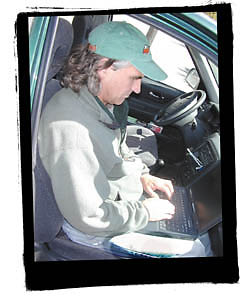
By Michael Burgwin (2003) Reno News & Review
“I wish I had the courage to put a gun in my mouth and blow my brains out,” Bobby tells me.
Extradited from the Midwest and jailed in Nevada for being delinquent in his child support payments, the wiry, hyperactive 40-year-old had tried to kill himself with an overdose of nitroglycerin tabs when he was 16. As doctors and nurses scrambled to save him from the eternal flatline, Bobby was visited.
“I was outside my body, watching them work on me from up above, when God told me, ‘Bobby, I’m not ready for you yet. It’s not time.’ “
Bobby was recently fired from a job for answering a question honestly rather than tactfully. When the employer contested his application for unemployment, he ran out of money, was evicted from his home and had to abandon everything he owned.
“The worse thing was I had to kill my dog,” he says. “Shadow was the best friend I ever had. But everything happened so suddenly, and I couldn’t find a home for him.”
He pauses to collect himself, tries to shake off some of the guilt.
“I love God, but I don’t understand what He has in mind for me.”
Homelessness has as many facets as it has faces. Every size, shape and color is represented in the exclusive club whose members have succumbed to their demons as they wrestle with their gods.
Not all of the stories being lived by those without homes are as dramatic as Bobby’s. Ben lost his job as a taxi driver when he stood up for his right to privacy. Don, in his early 50s, was diagnosed with diabetes and, just like that, lost his license to be a long-haul truck driver. Derek had been in jail for possessing too much weed in San Diego; when released, he headed north to avoid falling back into the same scene.
My own story, that of a Wooster High School graduate (1966) with a master’s degree in psychology who’s pursued a couple dozen different careers, has been less traumatic than many I have heard since I returned to Reno without income or home. It starts when I was arriving late one night at the end of a long drive from Seattle.
A COURSE IN MIRACLES
I have driven Highway 395 enough times to know how to get directly to the heart of town. Confident that I was locked into my spiritual path and that one or more miracles would take care of my basic needs, I intended to continue working on a writing project that I had started in earnest in the Virgin Islands–a sex, drugs, rock ‘n’ roll memoir, the whole Baby Boomer scene.
“What you need is a sponsor,” my short, sweet, insane Polish landlady in St. John informed me before I abandoned the Caribbean after a four-month stay.
“A sponsor?” I said.
“Yes, somebody who will pay your expenses until your book is finished,” she said. “People do it for artists and writers all the time.”
“That would certainly qualify as a miracle,” I said.
When I absentmindedly turned onto the first Reno exit, just south of Golden Valley, my efforts to correct my mistake in the dark led me deeper into Panther Valley and finally to a dead-end street and a dirt road leading into the desert. I was trying to find my way to a motel, so I mildly cursed myself for not paying attention. I began second-guessing my theory of being in tune with my inner guidance–what some people call God, Universe, Spirit or Higher Power.
Five days hunkered down in a cheap motel–writing all day and into the night and coming out only for a bite to eat once each day–quickly exhausted my resources with no signs of divine assistance. I wasn’t so sure that my reason for being in Reno didn’t include some serious growth experiences, the kinds that are accompanied by fear and discomfort if not outright pain. Fear equated to lack of faith, so I bit the bitter pill and prepared to live in my car.
The day before I moved out, a notice caught my eye in the newspaper. A local volunteer agency was beginning a round of training the next day, so I signed up. Thirty–five years of community work was not going to end just because I was without home or income. Besides, sharing a common interest with other Reno folks could expand my network, and that could lead to something.
With enough money for one more tank of gas, the issue of where to live in my car stumped me. Where could I park the car and live that would not attract the wrong kinds of attention? The answer came instantly: the dirt road in Panther Valley.
Suddenly, what I thought was a mistake revealed itself as an answer provided before the question. I had to smile at how quickly I was reminded, once again, that I was not alone on my journey.
The dirt road at the end of a small neighborhood led to a small, inactive hillside quarry that afforded me substantial desert privacy. Two sleeping bags, a down quilt, thin air mattress and feather pillow combined to make a fine bed. With a slight turn of the key, I had power for my computer and heat. Sunrise greeted me each morning with huge golden orbs of warm sunlight that thawed my frosted breath from the inside of the car windows.
Although a week of temperatures lingering in the teens made getting out of bed and dressing a race against frostbite, the solitude allowed me to sit in a meditative, often prayerful state. If I was going to receive a message from God, I wanted to be ready.
THOSE WHO DESPAIR FEAR RESIGNATION
Then my new reality began to sink in.
As I sat journaling in my car, I started to see the things that are finite and would cost money to replace: toothpaste, floss, soap, clean clothes. I’d been practicing gratitude, taking the time to be thankful for the good things in life. Being grateful for things I had always taken for granted was spiritually invigorating. But when I counted the silver coins in the ashtray, I found I had all of $3 and change. I already knew I was deep in credit card debt and that my debit card was down to $4 for emergency gas.
Panic struck the morning I lost my toothbrush. I hadn’t realized the degree to which my comfort zone was dependent on clean teeth. Fortunately, a grocery warehouse next to the state job center had good brushes for a price that fit my budget.
My comfort zone also presupposed that I would not be standing in line or sitting among the dirty and destitute at the local free lunch. However, contrary to the notion that it is possible to live on air, I was hungry. A mixture of fear and self-consciousness accompanied me as I surrendered to the only path clearly available to me.
Where was that miracle I was expecting?
When I went to the free lunch on Third Street, I expected to witness a lot of despair. Instead, I found resignation. The eyes, and the faces that absently hold them, told me that. The more I looked at the hundreds of storied faces and compared those looks to my own emerging feelings, the more I realized that those who despair fear resignation. By some quirk of existential madness, hope is the dialectical possibility residing in hopelessness. While despair can stop one’s life dead in its tracks, there is still the chance for a miracle: A few coins found on the street may pay off in a nickel slot machine, a guardian angel may wake up, or the Almighty Himself may intervene.
Those who are resigned to their fate have given up believing there is any other place for them than the place they now hold near the very bottom of the American social food chain. Often addicted to something–alcohol, drugs, sex, gambling–they have accepted their perceived fate. They have adapted.
Since my return to Reno, I have become keenly aware of the difference between despair and resignation. My own despair has been infrequent, tickling me now and then like the forked tongue of a curious but wary snake. I don’t like snakes, and I don’t like the implications of giving up.
I also believe in miracles.
In the line, waiting with nearly 400 of Reno’s hungry, I listened to family squabbles and murmured scams.
“Yeah, I drive this special camera to Carson City and pick up $300,” a scruffy middle-aged guy told two hungry-eyed friends. “The guy gives me a hundred for making the delivery. You guys wanna go catch a beer when we get out of here?”
My attachment to organic and naturally prepared foods, abandoned as a way to slow the cash drain, screamed bloody murder when I accepted a tray carrying macaroni with reconstituted cheese, stale bread, hardboiled egg, stale doughnut, cottage cheese and a cup of soup. As it does for so many of the daily diners, the soup, served in second and third helpings while the supply lasts, made my day. The soup is where the St. Vincent kitchen puts its limited supply of fresh vegetables and meat.
As the director for the past 11 years of the Catholic Community Services’ Dining Hall on West Third Street, Ray Trevino is responsible for converting the city’s leftovers to edible and nutritious lunches. That task, dependent as it is on the whims of consumers shopping at markets around the city, is seldom easy.
“About 10 percent of these folks are mentally hurt,” Ray said. “They need to be taken care of.”
I think about the wrinkled man with the coal-black face outside the dining hall just after my second visit. He was having it out with his invisible friend, laughing because he got to eat and his partner didn’t.
“Ha, ha, ha, ha, you motherfucker. I told you you couldn’t eat here. Your shelves are full at home, but I’ve got a full belly. Ha, ha, ha, ha.”
Schizophrenia on Third Street.
“Most of all, we are feeding the working poor here,” Ray concluded.
Trevino is no stranger to hard times. His story includes the youthful rise to success in the restaurant world as a business owner and director of food and beverage services for casinos and hotels in Reno. Following divorce, alcohol grabbed him and dumped him on the streets for about a year. After searching for some time, an ex-con to whom Ray had given a fresh start as a cook years before found Ray piled like dung on the edge of a sidewalk.
Somehow the man got through to Ray, said he needed him to take over the free-lunch program. After cleaning up, Ray became the director of the dining hall. Eleven years later, he still works full time forthe program, living in a small apartment off the dining area.
“I’ve seen some real miracles since I’ve been here,” he told me during a recent conversation in his office.
“Miracles?” I said.
POTATOES FROM HEAVEN
Sometime during Ray’s first two months at the dining hall, while planning for the next day’s lunch, Ray looked in the pantry and found three potatoes. He knew he couldn’t make soup for four hundred with three spuds, communicated that fact to God, and then surrendered the impossible task to his Creator.
“The next morning, about 8:30 or 9, I hear a guy outside knocking on the door. I opened the door and asked him what he wanted. He says, ‘I’m looking for a guy named Ray.’ ‘I’m Ray,’ I said. And he says, ‘Ray, California won’t let me take my potatoes across the state line, and I don’t want to just dump them someplace. Do you know anybody who can use 20,000 pounds of potatoes?'”
While the truck driver enjoyed a hot cup of coffee, Ray called around for places that could use potatoes. The 100-pound bags were off-loaded by a handful of volunteers, then, after filling every dining hall corner, distributed to food banks and kitchens in the Reno area.
Some days the line of hungry people is longer than the soup pot is deep. When the hall opens at 11:30 a.m., the line is already grown around the corner. Some days the lunches run out before everyone eats. Ray makes sure everyone who comes through the doors gets something, even if it doesn’t include soup.
“We see this every month,” he said. “Our numbers drop off right around the first of the month, when many of them get their checks. I’ve gotten to know a great number of them, and what I hear is that they go to the casinos until their money runs out, then [they] join us here again.”
Oh yeah, money.
The search for an income is a full-time job for many of my new colleagues. With few exceptions, the return on that investment is discouraging, at best. My first thought was to sell blood. Then I found out the local plasma bank will buy only from people who are residents with rent or utility receipts. The lack of an address and telephone number makes job applications suspect. A General Delivery address isn’t much better.
Nevada employment statistics suggest there are about 7,000 people unemployed in the Reno-Sparks area.
“As you have a prolonged recession, more people drop out of the labor force,” Nevada Employment economist Peter Janson said. “They get frustrated and stop looking for work.”
Nobody knows how many people are searching for work in a way that doesn’t show up in the statistics. Nobody knows how many people are underemployed.
“We see an increase in college enrollment during recessions,” Janson said. “Some go into business for themselves, while others give up all together.”
Now and then, employers looking to hire cheap labor prey on those feeling the most desperate. One such ploy puts the destitute on the sides of streets, where they try to sell newspapers when motorists stop at stoplights and stop signs or pull into shopping centers. Stories come back at the end of the days about selling one paper while standing in the cold all day with no food or water. The boss takes each person’s ID so that they can’t abandon their spot when they see that papers don’t sell where they are standing.
I’ve worked in about 32 different careers from writing for a small weekly newspaper in Washington state to working as a program developer for a small town parks and recreation department. Work has a different meaning for me these days. In St. John, the environment, heavy with heat and constant sweat, confined me to my writing desk, where there was no immediate income. Now, apathy steers me away from mainstream and mundane employment, even infects the applications and resumes I submit. A dozen applications; zero responses.
The process of surrendering to my dream and Divine Will may require employment with an outfit whose only redeeming value is that it has job openings. So, dressed in a pair of slacks and long-sleeved dress shirt and with shoulder-length hair, I offer myself to a health care facility and, when that fails, I storm the job office at a local casino, only to find that I am overqualified.
THIRTY DAYS IN THE RAC
After three weeks in my car, gas tank on empty, no centrally located place to park and sleep, I committed myself to the homeless shelter. What was one of Reno’s first fire stations is now the Reno Assistance Center, the RAC, where a little more than 100 homeless men can stay at any one time. As part of the Reno-Sparks Gospel Mission, the RAC is the last resort in Reno for homeless men who are not criminal enough for jail or prison, who aren’t mentally ill or otherwise disabled to qualify for other special services.
Intake was brutal, as one staff member after another was disrespectful, forceful and rude. None of them, not even the director, introduced themselves or extended a welcome. Assumptions about my character and intentions were lumped in with warnings and threats. No questions were allowed; no dialogue. When I felt anger rising in me, I caught myself, shook my head in disbelief. I had never been treated so poorly in all my adult life.
Where was the Christ in the Christian service? I wondered.
As I made my agitated and tearful way to the bunks, a new RAC mate warned me. “Get used to it,” he said.
The rules include lights on and out of bed at 5 a.m., and we must be back in the center by 5 p.m. Getting out of the center after 5 p.m. requires a letter from an employer or volunteer agency. Lights go out at 8 in the evening, and there are only a few specific times that personal items can be checked out or returned to safe storage. Don’t expect any courtesies when you check in or ask for your bags. Fortunately, there is no shortage of hot water in the showers.
One of the day supervisors summarized the RAC philosophy. “We’re not here to make it easy for you,” he reminded a group of residents grousing about the rules.
I woke up the next morning in a sea of bunk beds: 48 bunks neatly arranged where fire engines had once stood and where, later, Volkswagens had been rebuilt. The building is called the Bug House because of the huge, long-legged, black VW bug on the roof.
If I abided by the strict rules, bed number 63 belonged to me for 30 days. Ironically, that’s how much money I had–63 cents–since using my last $4 to keep the car in gas a few extra days. I wondered about the numerological implications of that coincidence. Was there a message from a higher power in that number?
The view from my top bunk lacked the romantic qualities that my car afforded during the prior three weeks. The air was dry and stale, filled with the breath of 50 or 60 half-sleeping men, many of them coughing uncontrollably all night long.
I knew if I couldn’t put together an income and a shelter before my time ran out, I’d be joining those who were living on the streets. As I walked from place to place, I saw them and their turf claimed along the freeways, the river and in back of industrial lots. Living on the streets precludes getting off the streets. Without the resources to maintain an optimistic attitude and stay clean, it would take a miracle to turn things around.
I wondered if my faith was strong enough to survive street life if it came to that.
WHERE DO YOU GO WHEN YOU’VE GONE TOO FAR?
There are between 4,000 and 5,000 homeless people each night in our community, including people in weekly motels, reports Anne Cory, CPO of United Way and chairman of the Reno Area Alliance for the Homeless.
I am one of those thousands, now alternating between my car, where I can get a good night’s sleep, and the RAC, where there is a bathroom, showers, breakfast and one hot meal each day. Occasionally, church groups prepare and serve home-cooked meals that are far superior to the RAC meals or any other free meal in town.
So, my new friends ask me, what is a white, middle-class dad with grown kids, a lengthy, varied resume and a laptop computer doing homeless in Reno?
There is an edge, a precipice, that marks the difference between secure and destitute, I tell them. I am homeless and unemployed as much because I have felt compelled to rub up against that edge and thereby strengthen my faith, as because circumstances drove me to this point. When I look back on my life, I see the footprints of something large and loving accompanying me. Instead of being dead at 19, I am alive and still growing at 54. I find myself on the bottom of the social crevasse because, piece by piece, I have let go of the mindset that prevented me from knowing and being fully comfortable with myself in the mainstream.
But I didn’t anticipate the anger I would encounter. Even the people I try to help share angry stories of abuse by other people, employers and the government. I didn’t realize how easily my own anger could be activated.
In the RAC, where conversations come easily during the spaces between lock-down and lights out, many people talk about trying to put distance between themselves and the behaviors that brought them to the bottom, behaviors that keep them close to the edge.
“I haven’t worked since October and am now five weeks behind on my child support payments,” Bobby says. “I have over 120 applications out there, and not one person has called me for an interview. It’s just a matter of time before my probation officer throws me back in the joint. What will I do then?”
 Unorthodox Truth